Resin Bound Driveways
Create exceptional resin bound driveways with Ovation Landscaping. Our collection of resin-bound gravel is made by mixing a UV-stable clear resin with natural stone aggregates such as quartz, granite or marble chippings, and adding optional extras like anti-slip additives and edging.
As long as your resin-bound driveway is laid on a porous surface, our gravel is practical for the rainy British climate and stays smart over time with straightforward maintenance. A rinse with a hose is often all you need. Our range includes Stonebound UV blends at 18mm (supplied with anti-slip glass), plus Terrabase UV options at 30mm, so you can create the resin-bound gravel driveway that best suits your project.
When you want a more stable alternative to loose gravel, our materials are ideal. These high-quality systems are made of a mix of tiny stones held together in resin for a smooth, hard-wearing finish – perfect if you don’t want scattered stones. When installed correctly on a suitable base, resin driveways have a long service life and a finish that keeps its colour. For optimal drainage, our resin-bound gravel surfaces should be paired with a suitable, well-prepared base.
If laying over a non-permeable base such as concrete, make sure the base has appropriate drainage in place. Order online for fast nationwide delivery, direct to your home.



In the planning stages of a driveway revamp, loose gravel is one of the most common materials people turn to.
Our decorative aggregates have many uses, but when laid inappropriately or in the wrong places, they can migrate into flowerbeds and create ruts under car wheels. A resin bound driveway, however, locks every stone in place.
It suits driveways, parking bays, paths and side returns – a resin bound driveway offers a solid surface for bins, bikes and prams or for connecting pathways that wind through a garden.
Ovation’s resin bound driveway options make it easy to get the look. Our Stonebound UV resin-bound driveway blends include shades like Sussex Gold, Silver Wood, Nevada Sand, Icicle, Castle Grey and Blizzard, and each is supplied with anti-slip glass and catalyst.
Or, for something slightly brighter, Luxe Marble Diamond UV and Scandinavian Pearl UV are available as 15mm resin-bound driveway options. What if you’re levelling out undulations, or you prefer a deeper build?
The Terrabase UV range is available at 30mm and includes the resin. This is all to help homeowners specify a system that meets the area's demands.
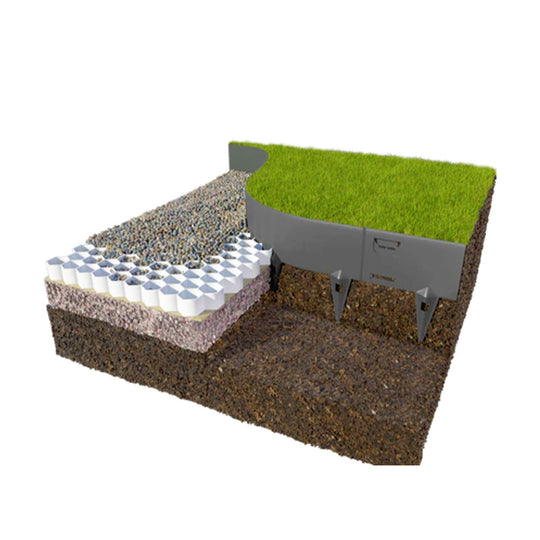
For the groundwork of your resin-bound driveway, Terrabase Geofabric (100m²) works as a separation layer, and Addagrid (25m²) can help stabilise sub-bases in areas that see turning or braking.
The best-looking resin-bound driveways are those with the most thoughtful details. To complete your revamp, we stock CORE EDGE premium lawn edging.
Supplied in packs covering a full 5 linear metres (with 65mm and 100mm face options), the edging is backed by a 10-year guarantee with an AkzoNobel powder-coated finish.
From a practical perspective, the permeability of resin-bound driveway systems is incredibly useful for the UK’s climate.
When installed on a suitable porous base, the open matrix structure allows rainwater to filter naturally into the ground (required for SUDS compliance).
Frequently Asked Questions
- What is the difference between resin-bound and resin-bonded?
- Do resin-bound driveways require planning permission in the uk?
- Are resin bound driveways permeable?
- What base do I need for a resin bound driveway?
- Will a resin-bound driveway fade or turn yellow over time?
- How do I clean and maintain a resin bound driveway?
- How long do resin bound driveways typically last?
- Can resin bound driveways be repaired if they’re damaged?
- Do sleepers need sealing or extra end-grain treatment after cutting?
A resin bound gravel driveway is where the aggregate is mixed with the resin first, then trowelled on to create a porous/permeable surface (when installed as a permeable system).
Resin-bonded is where a layer of resin is applied to the base, and the aggregate is scattered onto the top. This method leaves a rougher, textured finish that’s generally non-porous/non-permeable.
Usually, no – as long as your resin driveway is permeable/porous (rainwater can drain through) and complies with Sustainable Drainage Systems (SUDS) rules.
You’ll likely need planning permission if you’re creating or replacing a front driveway over 5m² using an impermeable (non-porous) surface that doesn’t drain to a permeable area.
Yes – resin-bound driveways are usually permeable (porous), meaning rainwater can drain through the surface and doesn’t sit on top. That’s because the mixed resin-and-aggregate system forms a matrix that allows water to pass through.
The key condition is the build-up: it must be installed over a suitable porous/permeable base to allow water to drain.
Resin driveways need a solid, stable base. If you want the surface to be fully permeable/SuDS-friendly, it should be installed over a suitable permeable base (not standard concrete).
Avoid laying resin-bound directly over block paving/flags (joints can reflect through) or onto a granular base such as MOT Type 1/gravel/sand.
Not if you use a UV-stable resin. Resin bound gravel made with UV-stable clear resin should resist yellowing and fading over time
Even with UV-stable resin, subtle weathering can happen over many years, depending on sun exposure, aggregate colour, and installation.
To clean resin bound driveways, you should sweep the surface regularly to remove leaves and debris, then rinse with clean water. For a deeper clean, use an occasional light pressure wash (don’t get too close or aggressive at the edges).
If you notice moss or algae, use a suitable treatment and rinse thoroughly afterwards. Clean up oil/chemical spills immediately and avoid solvents – they can damage the resin binder.
Most resin-bound driveways last around 15–20 years, and they can last even longer when installed correctly on a suitable base and given basic upkeep.
Yes – small areas can usually be patch repaired by chiselling/cutting out the damaged section and replacing it with a fresh mix of the same aggregate blend and resin.
If the damage is widespread or caused by a failing/moving base, the underlying issue needs to be fixed first, and a larger resurfacing may be required.
If you cut, drill or notch treated sleepers, you should apply an end-grain/cut-end preservative to the freshly exposed wood.
Two liberal brush coats should maintain the integrity of the original treatment, and sealing the whole sleeper with an oil/stain is optional for appearance, but it doesn’t replace cut-end treatment.